How the wrong concept of a “forgiven fallen angel” became internet lore.
Tracing the Origins, Transformations, and Misunderstandings of a Mysterious Angel.
 Introduction
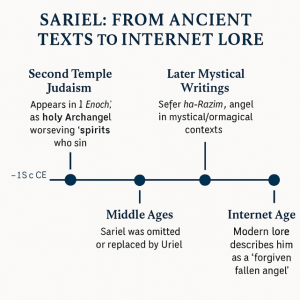
Among the names of angels that circulate through Jewish, Christian, mystical, and popular traditions, few are as enigmatic as Sariel. In some texts, he is listed among the seven holy archangels. In others, his name is missing, swapped, or confused with more famous angels like Uriel. By the time we reach the Middle Ages, Sariel’s place is largely erased from mainstream Christian teaching, yet he lingers in mystical, magical, and esoteric writings.
In recent decades, internet lore has given rise to a peculiar claim: that Sariel was the one fallen angel forgiven by God. This idea, however, is not supported by Jewish or Christian scripture, nor by the apocryphal writings where Sariel actually appears. Instead, the rumor seems to arise from a misreading of ancient apocalyptic literature, scribal name confusion, and later folkloric creativity.
This essay will explore Sariel’s story across the centuries, beginning in Second Temple Judaism and moving through rabbinic and mystical traditions, early Christian reception, medieval theology, and finally into internet-age speculation. Along the way, we will highlight how textual instability and interpretive gaps created fertile ground for modern myth-making.
Part 1: Sariel in Jewish Apocalyptic Literature
1 Enoch: The First Appearance
The earliest and clearest reference to Sariel comes from the book of 1 Enoch, a Jewish apocalyptic text written during the Second Temple period (roughly 3rd–1st century BCE).
In 1 Enoch 20, a passage enumerating the “holy angels who watch,” Sariel is listed among the seven archangels:
“And these are the names of the holy angels who watch:
Uriel, one of the holy angels, who is over the world and Tartarus.
Raphael, one of the holy angels, who is over the spirits of men.
Raguel, one of the holy angels, who takes vengeance on the world of the luminaries.
Michael, one of the holy angels, to wit, he that is set over the best part of mankind and over chaos.
Saraqael (Sariel), one of the holy angels, who is set over the spirits, who sin in the spirit.
Gabriel, one of the holy angels, who is over Paradise and the serpents and the Cherubim.
Remiel, one of the holy angels, whom God set over those who rise.”
This list is crucial. It shows that:
-
Sariel is considered a holy archangel, not fallen.
-
His special role concerns “the spirits who sin in the spirit,” a cryptic assignment that likely refers to judging or overseeing rebellious spiritual beings.
The Watchers Narrative
Elsewhere in 1 Enoch (chapters 6–16), we encounter the famous story of the Watchers—angels who descended to earth, took wives among human women, and fathered the giant Nephilim. Their leaders, names like Semjaza, Azazel, Kokabel, and others, are condemned for their rebellion.
Importantly, Sariel is not among these fallen Watchers. He appears only in the list of holy angels, not in the narrative of rebellion.
Moreover, the Watchers are explicitly denied forgiveness:
“You shall have no peace nor forgiveness of sin… From now on you shall not ascend into heaven for all eternity.” (1 Enoch 12–14)
Thus, the textual evidence could not be clearer: the idea of a fallen angel being forgiven is contradicted by the very book where Sariel appears.
Part 2: Textual Transmission and Name Confusion
Manuscript Variants
One of the main reasons Sariel’s identity is so unstable lies in the variant spellings and translations across manuscripts:
-
Ge’ez (Ethiopic): Saraqael
-
Greek fragments: Sariel (Σαριήλ)
-
Aramaic (Dead Sea Scrolls): ŚRYʾL (שריאל)
-
Later magical texts: Suriel or Souriel
-
Some manuscripts of 1 Enoch: swap Sariel for Uriel, leading to duplication or omission
This instability allowed Sariel to fade from mainstream recognition.
Suriel → Uriel Confusion
Later scribes and mystical compilers sometimes treated Suriel as a variant of Uriel, one of the better-known archangels. Because Uriel enjoyed broader recognition in Jewish and Christian angelology, Sariel’s name was sometimes dropped or merged.
This scribal blending had lasting effects: in Christian tradition, only Michael, Gabriel, and Raphael survived as officially recognized archangels (with Uriel admitted in some Eastern traditions). Sariel was left in obscurity.
Part 3: Sariel in Later Jewish Mystical Writings
Sefer ha-Razim
The Sefer ha-Razim (Book of Mysteries), a Jewish magical handbook from late antiquity, includes Sariel (SRYʾL) in rosters of angels ruling over the heavens. Here, Sariel is a name of power invoked in ritual magic, demonstrating that he retained currency outside canonical Judaism.
Hekhalot and Merkavah Literature
In Merkavah mysticism (3rd–7th centuries CE), angel names like Suriel and Sariel appear in vast catalogs of heavenly beings. These texts do not cast him as fallen but situate him in the liturgical and visionary cosmology of Jewish mystics.
Part 4: Sariel in Early Christian Reception
New Testament Context
In the canonical New Testament, only Michael (Dan 10, Jude 9, Rev 12), Gabriel (Dan 8–9, Luke 1), and Raphael (Book of Tobit, accepted in Catholic/Orthodox canon) are named.
The New Testament emphasizes that the angels who fell are kept in chains until judgment (Jude 6; 2 Peter 2:4). There is no category for “forgiven fallen angel.”
Patristic Writings
Early Christian writers such as Origen and Tertullian were aware of 1 Enoch. However, when it came to formal angelology, they restricted recognition to the better-known names. By the Middle Ages, Western Christianity officially recognized only three archangels.
Sariel faded almost completely, overshadowed by Uriel in some Eastern lists and forgotten in the West.
Part 5: Why the “Forgiven Fallen Angel” Idea Emerged
Now we come to the heart of the matter: how did modern lore turn Sariel into “the one forgiven fallen angel”?
1. Misreading 1 Enoch 20:7
The description of Sariel as being “set over the spirits who sin in the spirit” is enigmatic. Without the broader context of Enoch’s condemnation of the fallen, this phrase can sound like:
-
Sariel was once among the sinful spirits.
-
Sariel was their leader or judge.
-
Sariel’s role implies a liminal, in-between status.
This cryptic role seems tailor-made for imaginative reinterpretation.
2. Scribal Instability
Because Sariel’s name was unstable, appearing as Sariel, Saraqael, Suriel, or even replaced by Uriel, his identity was ripe for speculation. The lack of a fixed tradition left space for folklore to grow.
3. Esoteric and Magical Use
In magical texts, Sariel is invoked alongside angels and sometimes ambiguous powers. In this context, Sariel became associated with the margins of orthodoxy—another seedbed for lore.
4. Popular Fascination with “Exceptions”
Internet lore thrives on exceptions: the one angel who rebelled but was forgiven; the one fallen star who returned. Sariel’s cryptic role and obscurity made him the perfect candidate for such myth-making.
Part 6: Comparative Table of the Seven Archangels
Here’s how Sariel shifts across different traditions:
| Tradition | Archangels Listed | Sariel’s Role |
|---|---|---|
| 1 Enoch 20 (Ge’ez) | Uriel, Raphael, Raguel, Michael, Saraqael, Gabriel, Remiel | Holy archangel, over spirits who sin |
| 1 Enoch (variants) | Uriel, Raphael, Raguel, Michael, Gabriel, Remiel (+/- Saraqael) | Sometimes omitted |
| 2 Enoch (Slavonic) | Michael, Gabriel, others (+/- Sariel/Suriel in some MSS) | Variant guide |
| Sefer ha-Razim | Long rosters incl. Sariel | Angelic prince, invoked in ritual |
| 3 Enoch / Hekhalot | Expansive angel lists | Sariel/Suriel included |
| Christian canon | Michael, Gabriel, Raphael (Uriel in some Eastern traditions) | Sariel absent |
| Internet lore | Michael, Gabriel, Raphael, others… + Sariel as “forgiven fallen angel” | Folkloric misreading |
Part 7: Internet Lore and Modern Myth-Making
The idea of Sariel as a “forgiven fallen angel” appears to be a modern invention. Likely emerging from online forums, blogs, or mystical reinterpretations, it combines:
-
Enochic fragments (“spirits who sin”)
-
Folkloric hunger for redemption arcs
-
Esoteric angel lists from magical texts
This myth persists because:
-
It dramatizes the idea of divine mercy extending even to angels.
-
It makes Sariel stand out from the better-known Michael, Gabriel, and Raphael.
-
It appeals to readers who blend canonical, apocryphal, and esoteric sources without strict boundaries.
Conclusion
The story of Sariel is not that of a “forgiven fallen angel,” but rather of a faithful archangel whose name slipped through the cracks of transmission.
-
In 1 Enoch, he is holy, never fallen.
-
In later mystical writings, he remains an angel of power and mystery.
-
In Christian canon, he disappears.
-
In internet lore, he is reborn as a mythic exception—the one angel who sinned and was forgiven.
But this latter tale is folklore, not scripture. It reveals less about ancient Jewish or Christian theology than about modern imagination—how readers rework cryptic passages into redemptive narratives that resonate with some element of culture today.